

I had lunch with a longtime friend recently, and in the middle of a conversation that had absolutely nothing to do with neurodivergence, she asked me a question.
“What does it change if someone is autistic?”
My answer was immediate:
Nothing.
They’re the same person they were yesterday. Their brain didn’t suddenly become autistic because somebody recognized it. Their history hasn’t changed. Their personality hasn’t changed. The things you love about them haven’t changed. And the things that drive you absolutely crazy haven’t changed either.
But while they haven’t changed, something potentially very important has:
The framework for understanding them has changed.
And that can change quite a lot.
We interpret behavior through the explanations available to us.
This is especially important in relationships.
Imagine someone who is very rigid about the way things should be done. They don’t simply prefer their way. They seem completely baffled by why anyone would do it another way.
You offer an alternative and they argue with you. You explain your reasoning and they explain theirs again—only louder and with more detail. You tell them you understand their reasoning but simply don’t agree, and now they seem genuinely agitated.
After enough years of this, you probably have an explanation for that behavior.
He’s controlling.
She’s impossible.
He always has to be right.
She doesn’t care what anyone else thinks.
Everything has to be his way.
And sometimes those explanations may be accurate.
But sometimes there’s something else happening underneath the behavior.
Some autistic people have a much stronger need for certainty, predictability, consistency, or internal logic. Some think quite categorically. Once something has been established in their mind as the correct, safest, fairest, most logical, or most efficient way to do something, another person’s suggestion may not register as simply an equally valid preference.
It can register as wrong.
That’s very different from consciously thinking:
My opinion matters more than yours.
The behavior on the outside can look remarkably similar.
The internal process may not be.
And that distinction matters.
Understanding isn’t the same thing as excusing
This is where conversations about neurodivergence can get complicated.
If we discover that someone’s rigidity, emotional dysregulation, communication differences, sensory needs, or difficulty shifting perspective are related to autism or ADHD, it’s very easy to swing too far in one direction:
Oh. They can’t help it.
I shouldn’t upset them.
I need to accommodate this.
I guess this is just what being married to an autistic person is like.
No.
Understanding the neurological why behind a behavior does not determine what everyone else is required to tolerate.
This is one of the most important distinctions I often make in my work with clients.
Explanation and accountability can exist at the same time.
Someone may genuinely become dysregulated when their certainty is challenged.
And you are still allowed to disagree with them.
Someone may genuinely struggle to shift perspective in the moment.
And your perspective still matters.
Someone may experience an unexpected change as enormously distressing.
And that doesn’t necessarily mean the entire household must organize itself around preventing that distress.
Someone’s neurodivergence may explain why a particular interaction is difficult.
It does not automatically make harmful behavior acceptable.
Sometimes the person who changes is you
This was really the heart of the conversation with my friend.
Recognizing neurodivergence isn’t valuable because now we know what is “wrong” with somebody.
There isn’t suddenly something to fix.
The value is understanding the invisible wiring underneath what we’ve been seeing all along.
And once we understand that wiring, we can make different choices.
Maybe I stop interpreting your need for clarification as deliberately challenging me.
Maybe you stop assuming my forgetfulness means I don’t care.
Maybe I understand why changing plans at the last minute is so much harder for you than it is for me.
Maybe you recognize that when I say I need time alone, I’m regulating—not rejecting you.
Maybe I become more comfortable letting you be frustrated when I disagree with you instead of immediately changing my position to make the discomfort stop.
Maybe we finally recognize that we’ve spent twenty years trying to solve the wrong problem.
That’s not nothing.
That’s enormous.
A framework isn’t a free pass
There’s another reason I think understanding neurodivergence matters so much.
Without an accurate framework, we tend to fill in the blanks ourselves.
We assign motives.
We make character judgments.
And sometimes we excuse behavior we shouldn’t excuse because we’ve been told, “That’s just the autism” or “That’s just the ADHD.”
An accurate understanding should help us do less of both.
It should help us distinguish between neurological differences that require understanding and accommodation, relationship skills that can be learned, and harmful patterns that require accountability and boundaries.
Those things are not interchangeable.
And knowing someone is autistic or ADHD doesn’t answer every question about them.
It simply gives us better questions to ask.
So what does it change?
Maybe nothing.
You’re still you.
Your partner is still your partner. Your child is still your child. Your parent is still your parent.
No diagnosis—or self-recognition—rewrites the person who was already there.
But it can rewrite the story you’ve been telling yourself about that person.
And sometimes, that story has shaped a relationship for decades.
That’s why I don’t think the value of identifying neurodivergence is finding out what’s “wrong” so we can treat it or fix it.
It’s understanding how a particular brain experiences and navigates the world.
Because when the framework changes, our interpretations can change.
Our expectations can change.
Our communication can change.
Our boundaries can change.
And sometimes our relationships can change, too.
P.S. This question—what actually changes when we understand neurodivergence differently—is a core basis for why I wrote The Misunderstood Mind: What We Got Wrong about Autism, ADHD, and Neurodivergence.
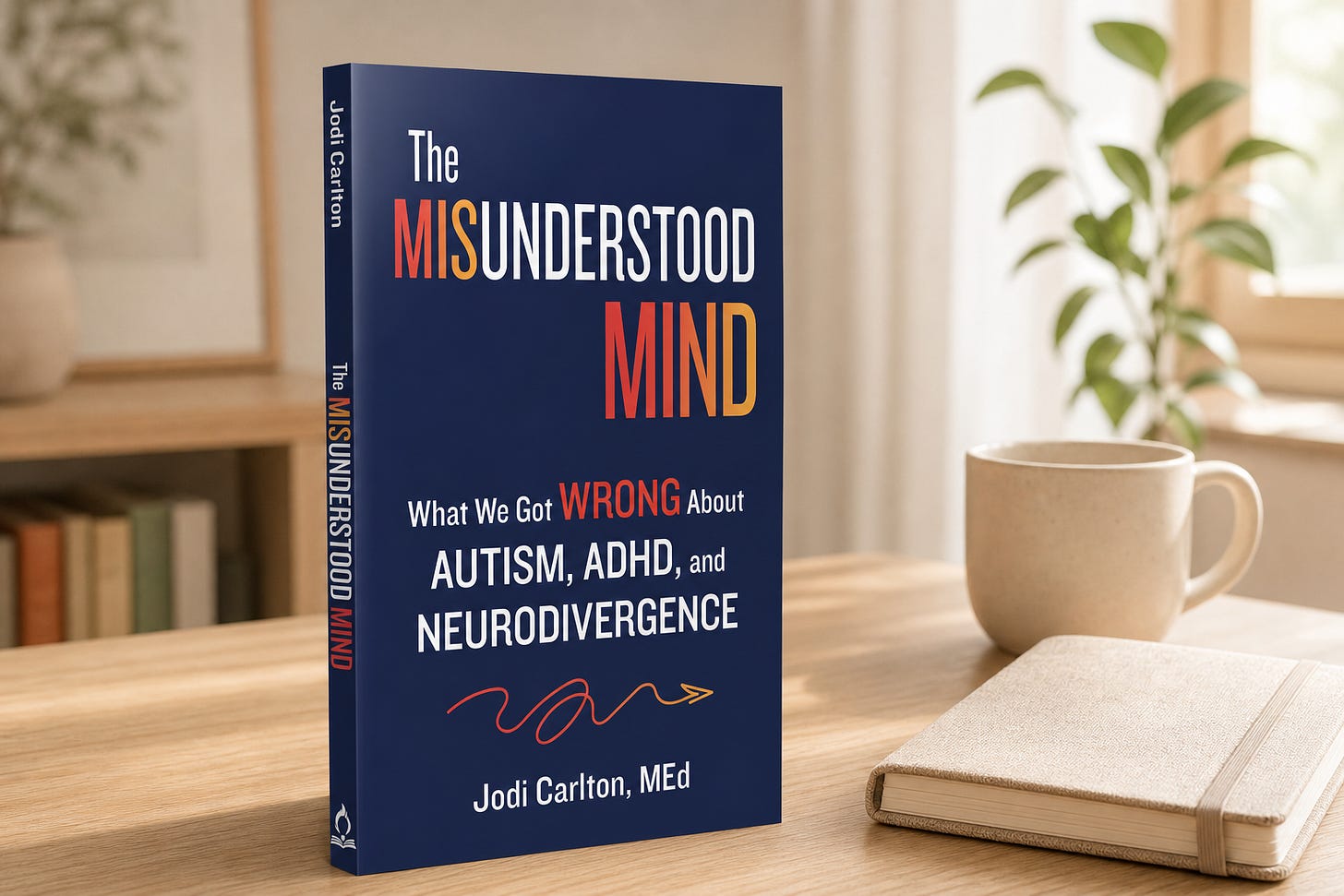
The book comes out October 6, 2026. If you’d like to read more about it or reserve your copy, you can do that here:


Leave a Comment